Knee arthritis is not one disease. It is four. Each stage looks different, feels different and needs a completely different treatment plan. The most common mistake patients make in PCMC is asking 'do I need a knee replacement?' on the first visit - when 70 percent of them are at a stage where surgery is not even on the menu.
Dr. Swaroop Solunke runs a stage-based knee arthritis clinic at Wakad. The first job is always to grade the arthritis correctly. The second is to match the treatment to the grade. The third is to give the patient enough information to make decisions calmly.
What Is Knee Arthritis?
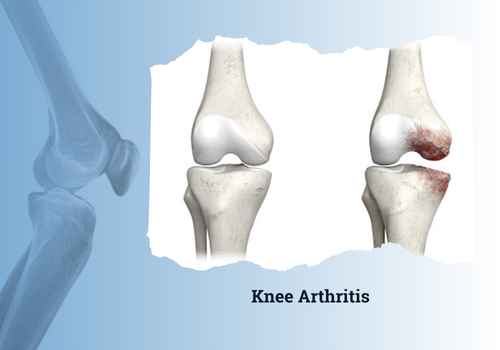
Knee arthritis is the gradual wearing-out of the cartilage that lines the inside of the knee joint. Cartilage is a smooth, shock-absorbing layer that lets bones glide past each other painlessly. As it wears, the underlying bone is exposed. The body responds with inflammation, fluid swelling, bone spurs and stiffness.
Three main types affect Indian patients.

Osteoarthritis
By far the most common. Wear-and-tear arthritis from age, repetitive use, weight and previous injuries. Affects mostly people above 50.
Rheumatoid Arthritis
Autoimmune. The body attacks its own joint linings. Often starts in younger patients (30 to 50) and affects both knees, both hands, both feet symmetrically.
Post-traumatic Arthritis
Develops years after a knee injury - a torn ACL, a fractured tibial plateau, a meniscus tear that was never properly treated.
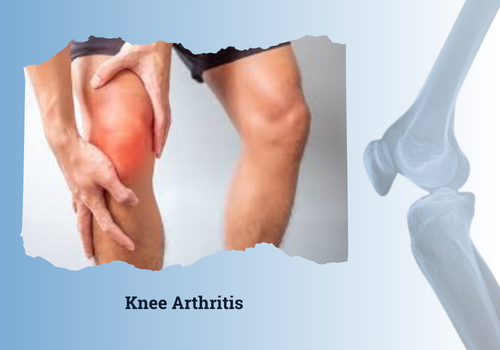
How Knee Arthritis Is Graded - Kellgren-Lawrence Scale
Grade 1 - Doubtful arthritis
Possible mild narrowing of the joint space, possible bone spur. Pain is intermittent, usually after activity. Most patients ignore it for years.
Grade 2 - Mild arthritis
Definite small bone spurs, possible joint space narrowing. Pain after walking long distances or climbing stairs. Stiffness in the morning that loosens within 15 minutes.
Grade 3 - Moderate arthritis
Multiple bone spurs, definite joint space narrowing, some bone deformity. Persistent pain even with rest. Difficulty climbing stairs, getting up from a chair, or walking more than 15 minutes.
Grade 4 - Severe arthritis
Large bone spurs, marked joint space narrowing, definite deformity, bone-on-bone contact. Constant pain, including at night. Walking is severely limited. Knee may bow inward (varus) or outward (valgus).
Stage-By-Stage Treatment Plan
Grade 1 to 2 - Lifestyle and Physiotherapy
Weight loss is the single most powerful intervention. Every kilogram lost reduces stress on the knee by approximately 4 kilograms. Quadriceps strengthening, low-impact aerobic exercise (swimming, stationary cycling) and short courses of paracetamol or NSAIDs as needed.
- Estimated cost: Rs. 5,000 to Rs. 15,000 over 3 to 6 months including physiotherapy
Grade 2 to 3 - Injections
When physiotherapy alone is not enough but the joint is not yet bone-on-bone, intra-articular injections make 6 to 18 months of pain relief.
- Steroid injection - fast relief, lasts 1 to 3 months. Cost: Rs. 1,500 to Rs. 4,000
- Hyaluronic acid injection - lubricates the joint, lasts 4 to 6 months. Cost: Rs. 8,000 to Rs. 15,000
- Platelet-rich plasma (PRP) injection - promotes cartilage health, lasts 6 to 12 months in some patients. Cost: Rs. 10,000 to Rs. 20,000 per session
Grade 3 - Partial Knee Replacement (when only one compartment is damaged)
If arthritis is limited to the inner or outer compartment of the knee and the rest of the joint is healthy, partial (unicondylar) knee replacement preserves more bone, recovers faster and feels more natural than a total knee replacement.
- Estimated cost: Rs. 1.7 to 2.5 lakh
Grade 3 to 4 - Total Knee Replacement
When the arthritis is in all three compartments of the knee and conservative treatment is no longer enough, total knee replacement is the definitive solution. Modern implants last 20 to 25 years.
- Single knee replacement: Rs. 1.7 to 2.5 lakh
- Bilateral knee replacement: Rs. 4.3 to 5.5 lakh
- Robotic knee replacement: Rs. 50,000 additional
When to See an Arthritis Specialist in Pune
Get More Information if you experience any of the following for more than two weeks.
- Knee pain that wakes you at night or persists at rest
- Morning stiffness in the knee that lasts more than 30 minutes
- Swelling around the knee that does not go away with ice and rest
- Difficulty getting up from a chair, sofa or Indian-style toilet
- Knee giving way or feeling unstable on stairs
- Visible bowing of the leg (varus or valgus deformity)
- Reduced walking distance - you used to walk 1 km, now you can do 200 metres
Linked Treatment Pages
This is the hub page for knee arthritis. For deeper information on specific treatments, see:
- Total Knee Replacement Surgery in Pune
- Partial / Unicondylar Knee Replacement
- Robotic Knee Replacement Surgery in Pune
- Bilateral Knee Replacement Surgery
- Minimally Invasive Subvastus Knee Replacement
- Knee Arthroscopy / Arthroscopic Knee Surgery