A fracture is the only orthopedic condition that does not give you time to research three doctors. You need someone close, someone available and someone good - in that order. Dr. Swaroop's Ortho and Polyclinic in Wakad is built around that reality. Same-day X-ray. Same-day decision. Surgery within 24 to 48 hours when needed.
What Is Trauma Surgery?
Orthopedic trauma surgery is the surgical fixation of broken bones, dislocated joints and severe soft-tissue injuries. Minor fractures (a hairline rib fracture, a non-displaced finger fracture) are managed in cast or brace. Significant fractures need internal hardware - plates, screws, intramedullary nails, or external fixators - to hold the bone in correct alignment until it heals.
Dr. Swaroop Solunke handles trauma cases that range from straightforward forearm fractures in children to complex multi-fragment hip fractures in elderly patients.
Common Fractures Treated at Our Wakad Clinic
Hip Fractures
Common in patients above 65, especially after a fall in the bathroom or from a low height. Without surgery, mortality at one year is high. With timely fixation or hip replacement, most elderly patients walk again within 6 weeks.
Femur (Thigh Bone) Fractures
Usually from high-velocity injuries - road accidents on the Mumbai-Bangalore highway, falls from height, sports collisions. Treated with intramedullary nailing through small incisions.
Tibia (Shin Bone) Fractures
Among the most common fractures in PCMC due to two-wheeler accidents. Closed nailing is preferred over open plating wherever possible - smaller scars, faster healing.
Ankle Fractures
Twisting injuries on stairs, sports, or uneven pavements. Plate-and-screw fixation gets most patients back to normal walking within 8 to 12 weeks.
Wrist Fractures
Almost always from a fall on outstretched hand. Distal radius fractures in adults often need plating; in children, manipulation under anesthesia and a cast is usually enough.
Elbow and Shoulder Fractures
Olecranon fractures, distal humerus fractures, proximal humerus fractures and clavicle fractures are treated case-by-case. Some heal beautifully in a sling. Others need internal fixation.
Hand and Finger Fractures
Often dismissed as minor. They are not - a poorly healed metacarpal can permanently affect grip strength. Mini-screws and K-wires give precise alignment with minimal scar.
Spine Fractures
Compression fractures from osteoporosis, burst fractures from falls or road accidents. Some need bracing; others need vertebroplasty, kyphoplasty or open fixation.
Pediatric Fractures
Children's bones heal faster but break differently. Greenstick fractures, growth-plate fractures and supracondylar humerus fractures need experienced handling - wrong treatment causes lifelong deformity.
What Happens When You Walk Into the Clinic With a Fracture
Minute 0 to 5: Triage
You are checked for airway, breathing and circulation first - even if you came on your own feet. Pain control begins immediately.
Minute 5 to 20: X-ray
Digital X-ray is done on-site. The clinic has its own X-ray unit so you do not have to travel anywhere with a swelling limb.
Minute 20 to 30: Diagnosis and Plan
Dr. Solunke reads the X-ray with you, marks the fracture lines on the screen and explains three things: what is broken, what fixing it looks like and what the timeline and cost are.
Hour 1 to 2: Stabilization
If immediate surgery is not required, the limb is splinted or cast and you go home with pain medication and a follow-up plan. If surgery is required, hospital admission paperwork starts now.
Hour 12 to 48: Surgery (if indicated)
Most fractures that need surgery are operated within 24 to 48 hours of presentation. Hip fractures in elderly patients are operated as soon as the patient is medically optimized - typically within 24 hours, since delayed surgery in this group raises mortality.
Minimally Invasive Fracture Surgery - What Makes It Different
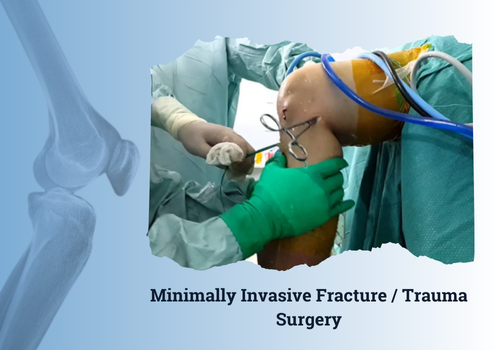
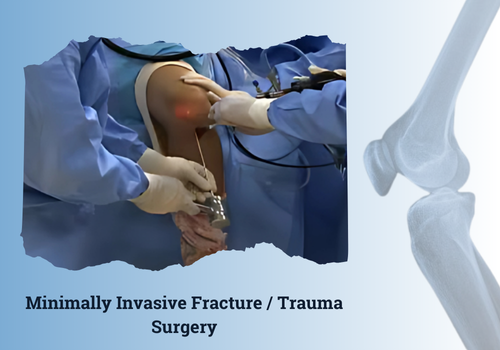
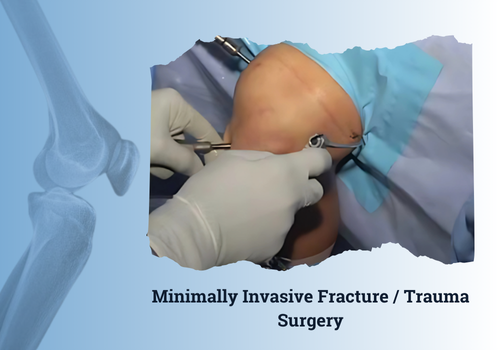
Traditional fracture surgery requires a long incision over the broken bone. The skin is opened, the muscle retracted, the bone exposed and the plate fixed under direct vision. It works, but it disrupts blood supply to the bone and produces large scars.
Minimally invasive plate osteosynthesis (MIPO) and closed intramedullary nailing both fix the bone without exposing it. The surgeon makes small incisions away from the fracture site and slides the implant under the skin or inside the bone canal, using fluoroscopy to guide placement. The bone heals faster because its blood supply is preserved. Scars are smaller. Hospital stay is shorter.
Cost for Fracture Surgery
Minor fracture (cast or brace, no surgery): Rs. 3,000 to Rs. 8,000 including X-ray and follow-ups
Wrist plating: Rs. 60,000 to Rs. 90,000
Forearm plating: Rs. 70,000 to Rs. 1.1 lakh
Tibia or femur nailing: Rs. 1.2 to 1.8 lakh
Hip fracture fixation: Rs. 1.2 to 1.8 lakh
Hip fracture treated with hip replacement (elderly patients): Rs. 1.2 to 1.5 lakh excluding implant and pharmacy
Complex multi-fragment fracture surgery: Rs. 1.5 to 3 lakh
Mediclaim is widely accepted, including cashless processing where available.
Recovery After Fracture Surgery
Recovery depends on which bone is broken and how. Broadly:
- Wrist fracture with plate: Splint for 1 to 2 weeks, then physiotherapy. Most patients are typing normally in 6 weeks
- Tibia or femur with nail: Walking with walker on day one, full weight-bearing by 6 to 12 weeks
- Hip fracture with screws or plate: Walking with walker in 1 to 2 days, stick by 6 weeks, no aid by 3 months
- Pediatric forearm in cast: Cast off in 4 to 6 weeks, full activities in 8 weeks